 |
| Edition 41 · October 16, 2026 |
The Arrangement of Attention |
|
| What twenty students can learn from each other depends on how we ask them to share a room. |
Dear Colleagues, Welcome to the 41st edition of Weekend Reads from CEPI. Picture a student in the third row. Her view of the class is different from that of the student in the first row. She sees the slides, the instructor and the backs of a dozen heads. When a classmate answers, she hears the words without seeing the face. Joining in means speaking toward the front while most of the room faces away from her. She suspects that from the front she is nearly invisible, and that she is called on less often. For students who would rather stay out of the discussion, the corner seats and the back row can become a kind of sanctuary. Most of us notice that choice. In the middle of teaching, the path of least resistance is to leave those students alone. We engage them less often than the students at the front. |
 |
| From the third row, the conversation happens somewhere up ahead. |
| Imagined class session | Concept: Anzar Khaliq, CEPI | Created with ChatGPT |
Nobody plans that pattern. The layout sets it up before class begins, and that is something we can design. We spend hours on our slide decks, choosing what goes on each screen and in what order. The layout of the room deserves the same thought, because where students sit decides who can talk to whom. Twenty chairs facing the front prepare everyone for a lecture, a monologue, a performance with one speaker and an audience. Teaching often needs that, since there are moments when everyone should be looking at the same explanation or the same problem. What the rows do little to prepare is a conversation among the students themselves, the kind that group work and peer discussion depend on. Every line of sight runs to the instructor, so the instructor becomes the easiest audience for every student’s thinking. We ask, someone answers, we respond. Nineteen other people may be thinking hard, and we rarely hear how their explanations compare. SFBU classrooms were built to allow something else. Our furniture is flexible, and our classes are capped at twenty. Three of our classrooms also have movable whiteboards, so students can think on a wall as well as on a page. Any of us can rearrange the room in a few minutes. Put the layout for each activity on a slide, and students can set up the room themselves. So the question to settle first is what we want students to do with each other’s thinking. Without that answer, we can rearrange every chair and leave the intellectual work exactly where it was. |
 From an SFBU Classroom
One SFBU professor brings name tags to class and places them on the chairs before students arrive. Each session starts with the seating he has planned for it, and every student begins the class within reach of a conversation. |
|
|
 From Rows to Pairs
|
| Start with the smallest change. The two diagrams below keep every student in the same spot. In the first, each exchange runs between a student and the instructor. In the second, students turn toward the person beside them, and ten conversations open up. Whether those conversations are worth having depends on what students have been asked to do. |
|
Rows Facing the Front 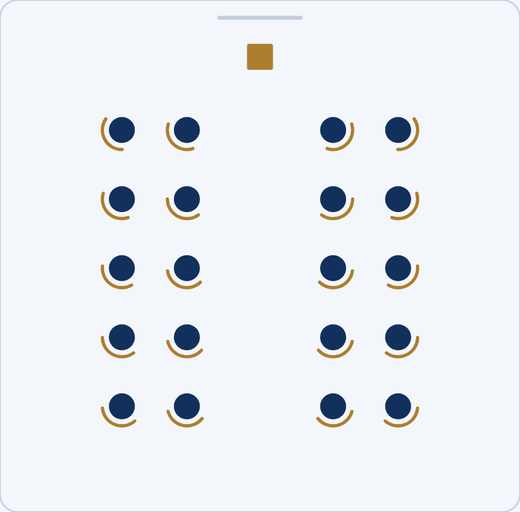 All twenty students face the instructor. | Pairs 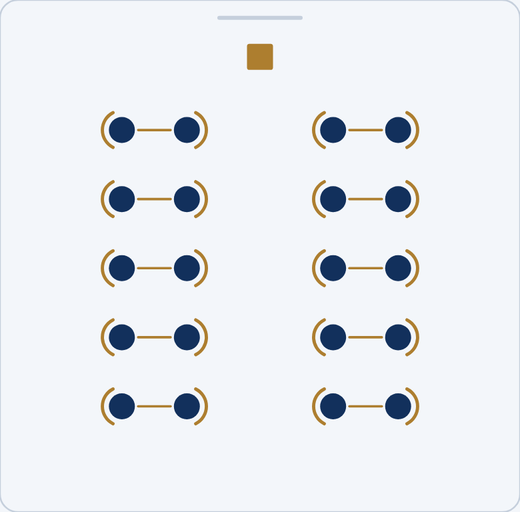 The same twenty seats, with each student turned toward a neighbor. | | ● Student ■ Instructor □ Shared work The gold arc is the back of the chair, and the open side shows which way the student faces. Lines show the exchanges each activity asks for. The diagrams are not drawn to scale. |
|
|
 Research Note
In a study published in 2012, Dr. D. Christopher Brooks of the University of Minnesota watched one award-winning instructor teach two sections of the same introductory biology course. One section met in rows facing a podium, the other at round tables with marker boards on the walls, and the syllabus was the same. In the rows, the instructor lectured in 77.4 percent of observed intervals, and at the round tables in 54.5 percent. Consultation with individual students and small groups occurred in 27.4 percent of intervals in the rows and 54.9 percent at the round tables. The whole room changed at once, so the study cannot say which feature did the work. [1] |
|
|
 Groups of Four
|
Push four chairs together and the question is still open. Four students might listen to the instructor, split a worksheet into four unrelated pieces, or wait for the most confident person to supply the answer. They might also find that they read the same evidence differently and work through the disagreement. From the doorway, both groups would look the same. If the task is to agree on an answer, the group finishes as soon as someone sounds convincing. Now ask students to find where their explanations differ and test that difference against the evidence. Each person’s reasoning becomes material the others need. This is the purpose a flexible room serves. It lets students hear and examine thinking that would otherwise travel only between one student and the instructor. |
 Research Note
Dr. Michelene Chi and Dr. Ruth Wylie of Arizona State University created the ICAP framework. It sorts student engagement into four kinds: receiving information, working with material, generating explanations, and building understanding with others through dialogue. The framework uses what students do and produce as evidence of how they are thinking. A busy group may still offer little evidence that students are examining each other’s ideas. [2] |
|
Groups Facing the Front 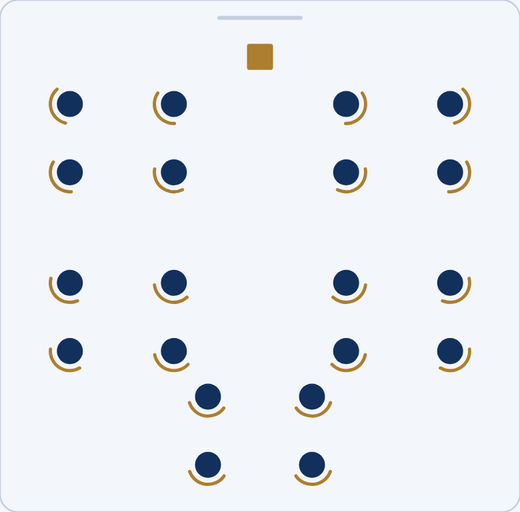 Five groups of four still face the instructor, so the class can still run as a lecture. | Groups Around Shared Work 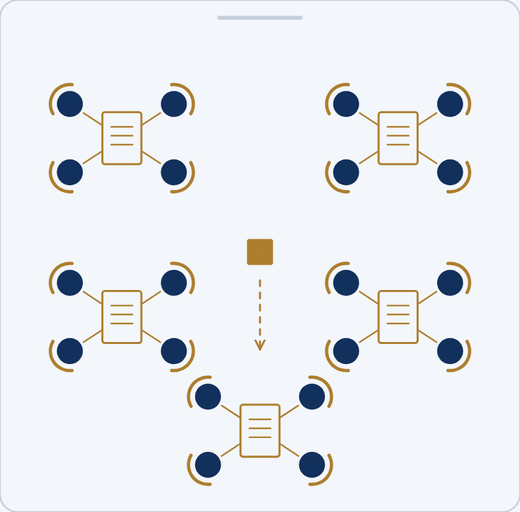 Each group faces its shared page. The dashed arrow shows where the instructor might walk. |
|
|
|
 A Sample Class Session
|
Imagine a class weighing two responses to the growing energy demand of data centers. A region can build new power plants to meet the load. It can also require new data centers to supply part of their own power, for example with solar panels and batteries. The instructor opens with a short explanation of the constraints and the evidence, a few minutes in which everyone needs the same point of reference. Each student then writes down a judgment before comparing reasons with a neighbor. The pair has something to talk about because each person arrives with a position; neither has to invent an opinion while the other speaks. Then the pairs turn their chairs and become five groups of four. Each group writes a recommendation, names the assumption it rests on, and records the strongest objection raised inside the group. In a room with movable whiteboards, each group can roll one over and sketch where the power comes from and where it goes. Then the argument has a shape everyone at the table can point to. As the instructor circulates, differences surface that a whole-class question would have missed. One group has misread a constraint. Another has made an inference it cannot support. A third has found a disagreement worth bringing to the whole room. If groups of four make the room loud or crowded, the work can stay in pairs. Next, the groups exchange their recommendations, take a challenge from another group, and decide whether their argument survives. Each group passes its page to the next, or rolls its whiteboard over, so every student sees other groups’ reasoning from their own seat. |
 Research Note
The University of British Columbia’s Accessible Active Learning guide adapts the gallery walk. The posters travel from group to group, and students stay at stations chosen with mobility in mind. The small-room sequence above is CEPI’s adaptation of that idea. [3] |
|
Passing the Work 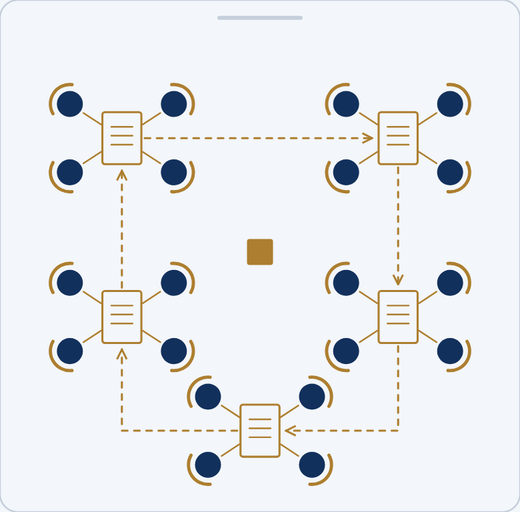 Each group passes its page to the next group for critique, and students stay seated. The arrows show the pages changing hands. |
|
When the class comes back together, the instructor has something specific to work with. Two recommendations may expose a question in the discipline that nobody saw at the start. The instructor can examine that difference with everyone, correct a misunderstanding, or explain what the evidence cannot settle. Then each student returns to their first judgment and revises it in writing. A persuasive group answer tells us about the group, and the written revision shows what each person now understands. |
|
 Asking Students About the Room
|
Our view from the front is one view of the room. An arrangement that looks right from the front can be hard to use from one of its seats. A student may be unable to see the shared work, follow four voices at once, or get easily between groups. Asking students what they could hear, see and contribute tells us what watching the room cannot. A steady seat, a clear path or a written contribution can open an exchange to someone it would otherwise leave out. No student should have to explain an access need in public to take part. That feedback belongs in the next decision about the room. Flexible furniture gives us the means to respond, and the twenty people who sit in it can tell us what to change. |
 Research Note
Dr. Teri-Lisa Griffiths of Sheffield Hallam University and Dr. Jill Dickinson of Leeds Beckett University studied seventeen students at a university in northern England. They followed the students through the 2020–21 academic year, as teaching shifted online under pandemic restrictions. They recommended that students and educators shape decisions about learning spaces together. [4] |
|
 Weekend Prompt
Take one class you will teach next week. Sketch the room with a dot for each student and a different mark for yourself, then draw the exchanges your planned activities require. Where must students explain something to a peer, examine another group’s work, or reconsider their own reasoning? Where does every line run back to you?
Choose one point in the session where a new arrangement would let students examine reasoning they now hear only through you. Decide what they will produce and what you will look at afterward. Before class, predict what their revisions will show. After class, ask students where the arrangement helped them follow or contribute, and where it got in the way.
Send us your sketch and what the class showed you, and we’ll compare notes.
|
|
References
| 1. | Brooks, D. C. (2012). Space and consequences: The impact of different formal learning spaces on instructor and student behavior. Journal of Learning Spaces, 1(2). | | 2. | Chi, M. T. H., & Wylie, R. (2014). The ICAP framework: Linking cognitive engagement to active learning outcomes. Educational Psychologist, 49(4), 219–243. | | 3. | University of British Columbia. Gallery walk. Accessible Active Learning. blogs.ubc.ca/accessibleactivelearning/gallery-walk. The small-room sequence above is CEPI’s adaptation. | | 4. | Griffiths, T.-L., & Dickinson, J. (2025). There’s power in the community: A sociomaterial analysis of university learning spaces. Higher Education, 89, 387–405. |
|
|
|
Wishing you a reflective and restorative weekend.
Warmly,
Center for Empowerment and Pedagogical Innovation (CEPI)
© 2026 CEPI. All rights reserved.
|