 |
| Edition 42 · October 23, 2026 |
The Final Assignment, Reimagined |
|
| What if the arrival of AI is an invitation to ask more of our students? |
Dear Colleagues, Welcome to the 42nd edition of Weekend Reads from CEPI. |
|
 Scene One: A Familiar Classroom
|
Picture the final week of the semester. Students have spent weeks on their projects, and one group after another comes to the front of the room. The slides are polished, the transitions are smooth, and the content is neatly organized. Some presentations look almost professional. Then someone asks a question. “Why did you choose this approach?” One student hesitates. Another repeats a line from the slide. A third gives a confident answer that sounds right and comes apart at the second follow-up question. Perhaps the students understand more than they can say in that moment. Perhaps they learned a great deal. Perhaps the polished deck covered real gaps in their understanding. Often we cannot tell which. Generative AI has made this harder to ignore. A student can now research a topic, outline it, build a polished deck and write speaking notes with very little effort. None of those steps needs the depth of understanding the assignment was meant to build. Presentations can still be good assessments, especially when students must defend their reasoning and answer questions they did not see coming. If the finished deck is our main evidence of learning, though, we may be measuring something we never meant to measure. |
| As finals approach, each of us can ask one question about our own course. What will my students have to show me that convinces me they met the outcomes of this course? |
 Research Note
In 2023, Australia’s higher education regulator, TEQSA, published a paper on assessment reform for the age of AI. Its authors include Dr. Jason Lodge of the University of Queensland and Dr. Phillip Dawson of Deakin University. They argue that assessment should prepare students to work ethically in a world where AI is everywhere. The authors also argue that trustworthy judgments about learning need several kinds of evidence, gathered in different ways. [1] |
|
|
 Scene Two: Another Classroom
|
Imagine another class in the same final week. These students have also spent weeks on real-world problems. They have gathered evidence, read data, interviewed people and built a growing understanding of the issue in front of them. Here, no team walks to the front to present a deck. Each team designs and leads a thirty-minute learning session for their classmates, and the questions that unsettled the first room become part of the plan. |
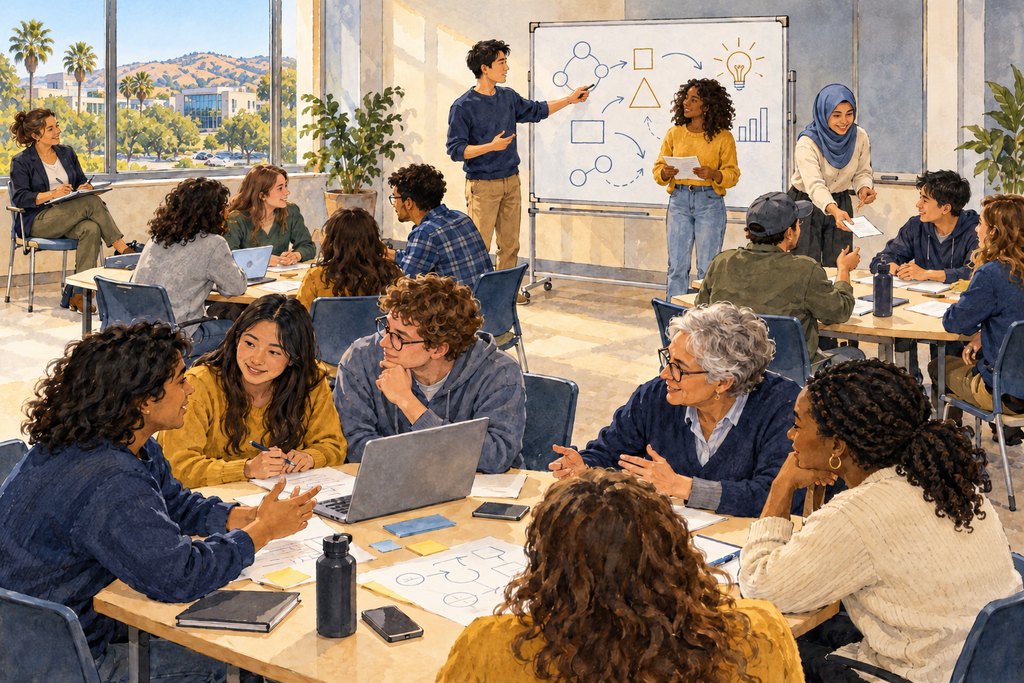 |
| Students lead the session, a guest joins a table, and the instructor watches from the side. |
| Imagined class session | Concept: Anzar Khaliq, CEPI | Created with ChatGPT |
Before the workshop, the team writes a short reading packet for classmates, so they arrive ready to work on the problem.
During the workshop, the team opens with a brief slide deck that frames one important idea. Then it leads an activity in which participants investigate part of the problem themselves and contribute through discussion, analysis or shared work.
After the workshop, the team writes a synthesis of what happened, what participants contributed, and what the session revealed about the problem. |
|
In this assignment, students are expected to use AI throughout. Over the course, they have learned to strengthen their research and design work with AI tools. Their own judgment and decisions stay at the center of that work. They can use AI to research, organize information, draft the packet, design activities, build slides and prepare their facilitation notes. |
| The standard rises with the tool. If AI can produce a reasonable first draft in seconds, why should a reasonable first draft be enough? |
The packet must be accurate, readable, properly sourced and worth a classmate’s time. Students answer for every claim and every sentence in it, however it was produced. The workshop must be designed with care. Every activity needs a learning purpose. The team has to anticipate misunderstandings, handle unexpected questions, manage participation and adjust when the room heads somewhere new. Each student shows their own understanding through how they facilitate, question, explain and reflect. Teams may also invite a few guests with a real connection to the problem. A guest might be a faculty member from another discipline, a staff colleague, a family member or someone from the wider community. Guests bring perspectives the class does not have, and they make the workshop part of the SFBU community. Checkpoints run through the weeks before the final, for the instructor and for peers. Each team first submits a proposal naming the idea it will teach. The instructor and another team then review a draft of the reading packet. A short run-through with the instructor tests the activity before the day. During the workshop, classmates’ questions test each facilitator. Afterward, each student answers one question alone and writes a short reflection. A strong team workshop can still carry a member who has not mastered the material. For that reason, every checkpoint looks at individual students as well as the team. Thirty minutes is deliberate. It gives the students leading the workshop time to show a real grasp of the subject. It also gives participants time to learn something they can show. With classes capped at twenty, every team has room for a full session. Faculty can choose a different length for their own context, as long as it leaves room for both. |
 Research Note
Dr. Logan Fiorella and Dr. Richard Mayer of the University of California, Santa Barbara published a study in 2013. In it, college students learned a lesson on the Doppler effect. Students who prepared to teach it scored higher on an immediate test than students who prepared for a test. Students who then taught the lesson on video scored highest on a delayed test. [2] |
|
 From CEPI Labs
This workshop final is a running experiment at SFBU this fall. It is part of CEPI Labs, our space for testing new approaches to teaching, learning and assessment. We will share what it shows us. |
|
|
 Scene Three: Your Classroom
|
The second classroom may look different from yours. You may teach accounting, mathematics, computer science, business or English. Your final may be an exam, a paper, a case analysis, a presentation or a technical project. A workshop will suit some of those and not others. Now that AI can complete large parts of many tasks, it is worth looking again at what your assessment asks students to do. Some assessments need a small adjustment. Others need a fuller redesign. Some already give clear evidence of learning, and finding that out is useful too. Across higher education, many of us are returning to handwritten exams and other familiar safeguards. It is a reasonable response when we have no other approach we know well and trust to work. It does not yet answer the question AI has raised about what students should learn and show. Before returning to those safeguards, work through these four questions. |
Four questions for your final | What could students now accomplish with AI that was hard or impractical before? | | What higher standard could we reasonably expect? | | What new experience could we create? | | How will each student’s understanding become visible? |
|
|
If your syllabus leaves room to change the final this term, tell students early and in writing. If it does not, plan the redesign for next term. |
 Weekend Prompt
This weekend, redesign one assessment, even if only on paper. Choose one of the two routes below.
You may find one small change worth trying next term, or a larger experiment worth discussing with colleagues, and either one is a good result.
If AI has changed what students can produce, what might we now ask them to learn, do and create? Send us your redesign, and we’ll compare notes.
|
|
 The Paper Route
The two-sided Assessment Redesign Worksheet walks you from your learning outcomes to a new design in twelve short questions. The link makes your own copy in Google Docs, which you can fill in on screen or print. |
|
 The Conversation Route
The CEPI Assessment Redesign skill in ChatGPT is open to everyone at SFBU. Open it with the button below, or find it under Skills in ChatGPT, in the list shared by SFBU. Share your current assignment or final exam, answer its questions about your course, and it will help you draft and critique new versions. New to skills? The four-step picture guide shows you how to add it and use it. |
|
|
References
| 1. | Lodge, J. M., Howard, S., Bearman, M., Dawson, P., & Associates. (2023). Assessment reform for the age of artificial intelligence. Tertiary Education Quality and Standards Agency. | | 2. | Fiorella, L., & Mayer, R. E. (2013). The relative benefits of learning by teaching and teaching expectancy. Contemporary Educational Psychology, 38(4), 281–288. |
|
|
|
Wishing you a reflective and restorative weekend.
Warmly,
Center for Empowerment and Pedagogical Innovation (CEPI)
© 2026 CEPI. All rights reserved.
|
|
|